Section 10
Chapter 47 - Thinking abstractly
Computational thinking
Computational thinking is not just about following a set of instructions, but rather about understanding how to break down complex problems into manageable parts and solve them systematically.
These involves 2 simple steps:
- Formulate a problem as a computational problem (so it is potentially solvable by an algorithm)
- Try to construct an algorithm to solve the problem
The solution must be correct, efficient, and scalable.
Abstraction
Abstraction is the process of simplifying unnecessary details.
For example, let's take Elite Dangerous.

In reality, space travel would involve high-level physics, orbital mechanics, and thousands of tiny technical variables. But the game doesn't make you calculate fuel scooping rate or gravitational constants manually.
Instead, it abstracts all that complexity. It gives you a clean interface and a ship that "just flies," letting you focus on the fun stuff, like deciding which star system to explore next or how to manage your resources. You get all the experience of being a pilot without needing a PhD in astrophysics to fly your ship. (idk just had to make elite dangerous reference)
Abstraction in high level languages
High-level programming languages abstract away low-level details, allowing developers to write code that is more readable and maintainable. For example, in Python, you don't need to manage memory manually like you would in C. Instead, Python handles memory management for you, so you can focus on solving the problem at hand.
This allows developers to focus on the logic rather than worrying about low-level implementation details.
Chapter 48 - Thinking ahead
Thinking ahead is a vital skill in programming and problem-solving. It involves thinking about potential issues, considering edge cases, and planning for future requirements. By thinking ahead, developers can write more maintainable and much more reliable code.
Benefits of caching
Caching is done automatically and improves performance by reducing the need to recalculate data.
For example, in web development, caching can significantly reduce the load on a server by storing frequently used data in memory, which means that similar requests can be processed faster without recalculating the same data.
Chapter 49 - Thinking procedurally
Procedural abstraction
Procedural abstraction is used to carry out a sequence of steps for achieving some task.
For example, you can code a program to calculate the area of a triangle by defining a function that takes base and height as inputs and returns the area.
def calculate_triangle_area(base, height):
    # Calculating the area
    return 0.5 * base * height

# We just call the function without worrying about how it works
area = calculate_triangle_area(10, 5)
print(f'The area is: {area}')
The programmer doesn't need to know the internal details how the function works, as long as they know what inputs it takes and what output it produces.
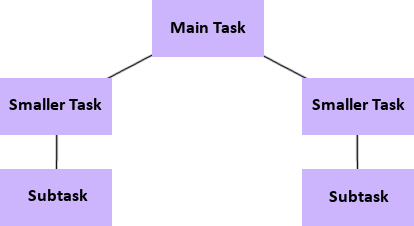
Hierarchy charts
A hierarchy chart is a tool for representing the structure of a program, showing how the modules relate to each other to form the complete solution. The chart is depicted as an upside-down tree structure, with modules being broken down further into smaller modules until each module is only a few lines of code.